
Do You Need to Be Flexible to Start Yoga?
“I’d love to try yoga, but I can’t even touch my toes.”
If that sounds familiar, you may have been putting off your first class because you feel you need to become more flexible before joining.
The answer is reassuring: you do not need to be flexible to start yoga. NHS inform advises that people should not worry about being insufficiently flexible or fit to try it, and points to beginner classes as a place to start. NHS inform
You can arrive with limited flexibility, questions and no previous experience. What matters is finding an appropriate class and learning how to practise within your current abilities.
Why flexibility can feel like an entry requirement
Photographs of yoga often feature deep stretches, impressive balances and people folding into positions that look impossible.
Those images show a particular moment in someone’s practice. They tell you very little about what happens in a beginner class or how that person started.
Yoga also includes breathing, attention and meditation alongside physical postures. There is plenty to learn without making a dramatic shape. NCCIH
Your first session can begin with understanding instructions, exploring manageable movements and noticing how you feel. Touching your toes does not need to be on the agenda.
What does yoga for inflexible beginners look like?
A suitable beginner class gives you the opportunity to learn the basics and ask for guidance when a movement feels unfamiliar.
Tell the teacher which positions you find difficult. You might struggle to sit comfortably on the floor, reach towards your feet or raise your arms. These practical details help the teacher understand what support you need.
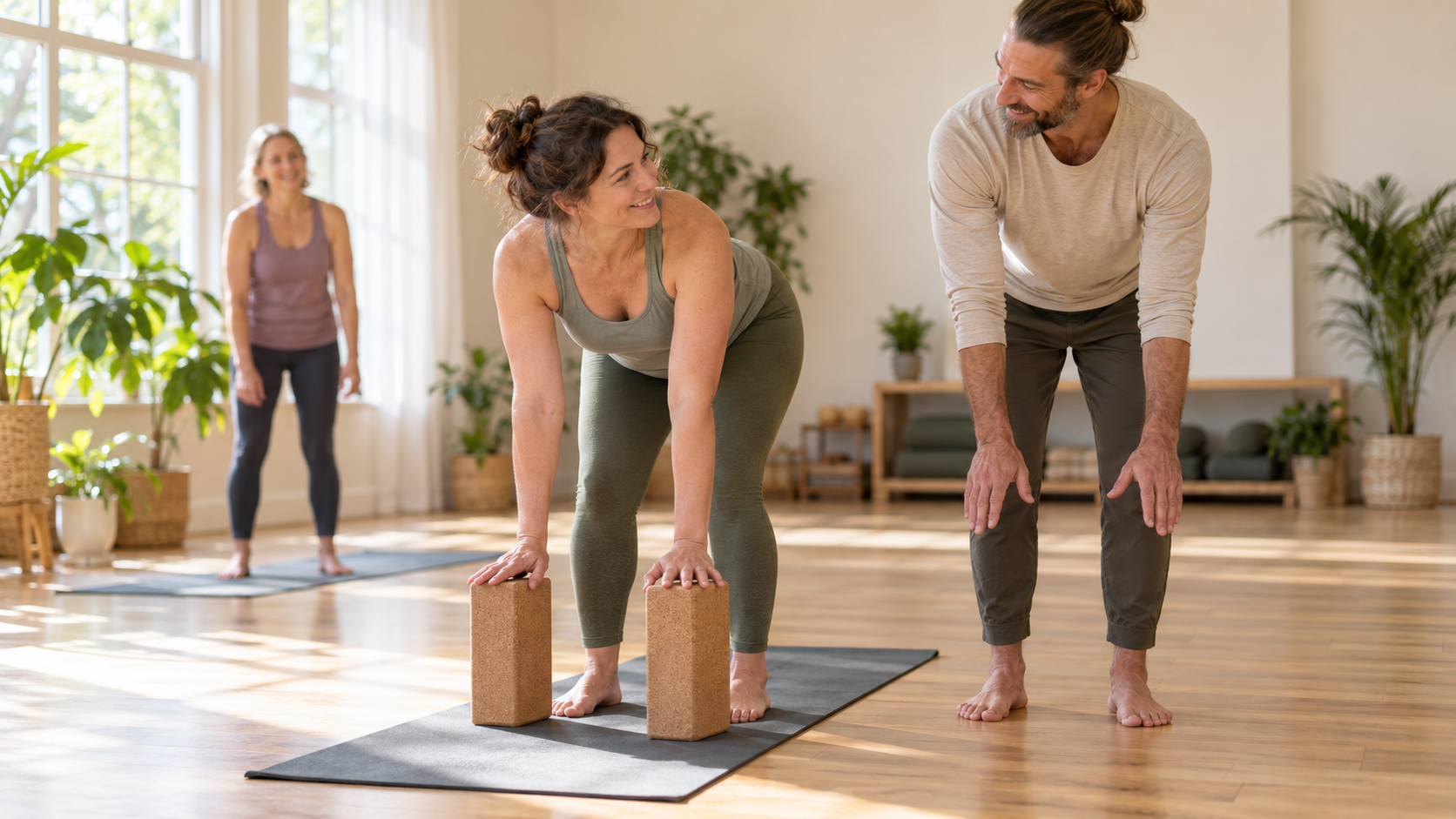
Depending on the posture and your circumstances, the teacher may suggest a smaller movement, a different position or a suitable support. Ask what equipment is available rather than assuming every class provides the same options.
For example, if the teacher introduces a forward bend, explain that reaching down is difficult and ask how to approach it. Let the teacher guide the adjustment instead of forcing yourself towards the floor.
You are learning a movement, and questions are part of that process.
How to start at your own pace
Practising at your own pace means making choices that suit you during the session. It can mean taking time to understand an instruction, using an alternative suggested by the teacher or pausing when you need to.
Before class, ask how to signal for help and what to do if you cannot comfortably follow a posture. Having that conversation early can make it easier to speak up later.
Avoid forcing a movement or pushing through pain. If something hurts, stop and tell the teacher. Existing injuries and some health conditions may require particular modifications, so seek advice from a relevant healthcare professional if you are unsure what is appropriate for you. NCCIH
A useful aim for your first class is simple: learn something, ask the questions you need to ask and get a sense of whether the session suits you.
Will everyone else be more flexible?
Some classmates may have practised for years. Others may be attending for the first time. Even people with similar experience can find different movements comfortable.
Looking around the room can be helpful when learning an unfamiliar instruction, but comparing how far everyone can bend is unlikely to help you choose what works for your body.
Bring your attention back to your own experience. Can you follow the explanation? Do you know how to ask for an alternative? Are you comfortable taking a pause?
These are more useful first-class questions than whether your posture looks like someone else’s.
How do you choose the right beginner class?
When looking for yoga classes in Liverpool, start by asking about the level, pace and teaching approach.
You could say: “I’m completely new to yoga and don’t feel very flexible. Is this a suitable class for me?”
Follow up with a few practical questions:
Does the teacher explain the postures step by step?
Can students ask for alternatives to difficult movements?
Does the class involve frequent transitions to and from the floor?
What should you bring for your first session?
At Shiva Yoga, Mohan leads classes across Liverpool welcoming beginners through to experienced practitioners. The timetable includes several beginner levels, and you can contact him for help choosing a starting point. Shiva Yoga
Give yourself room to learn
You may hope to become more flexible, but avoid setting a deadline for reaching a particular position. Start with a routine you can realistically manage and discuss your progress with the teacher.
Notice the smaller parts of learning too: recognising an instruction, feeling comfortable asking a question or understanding which variation suits you.
For your first visit, give yourself permission to be a beginner.
If flexibility has been holding you back, explore Shiva Yoga’s Liverpool class timetable and contact Mohan to discuss a suitable session.
You can begin with the flexibility you have today.