
What Do You Learn on a 200-Hour Yoga Teacher Training Course?
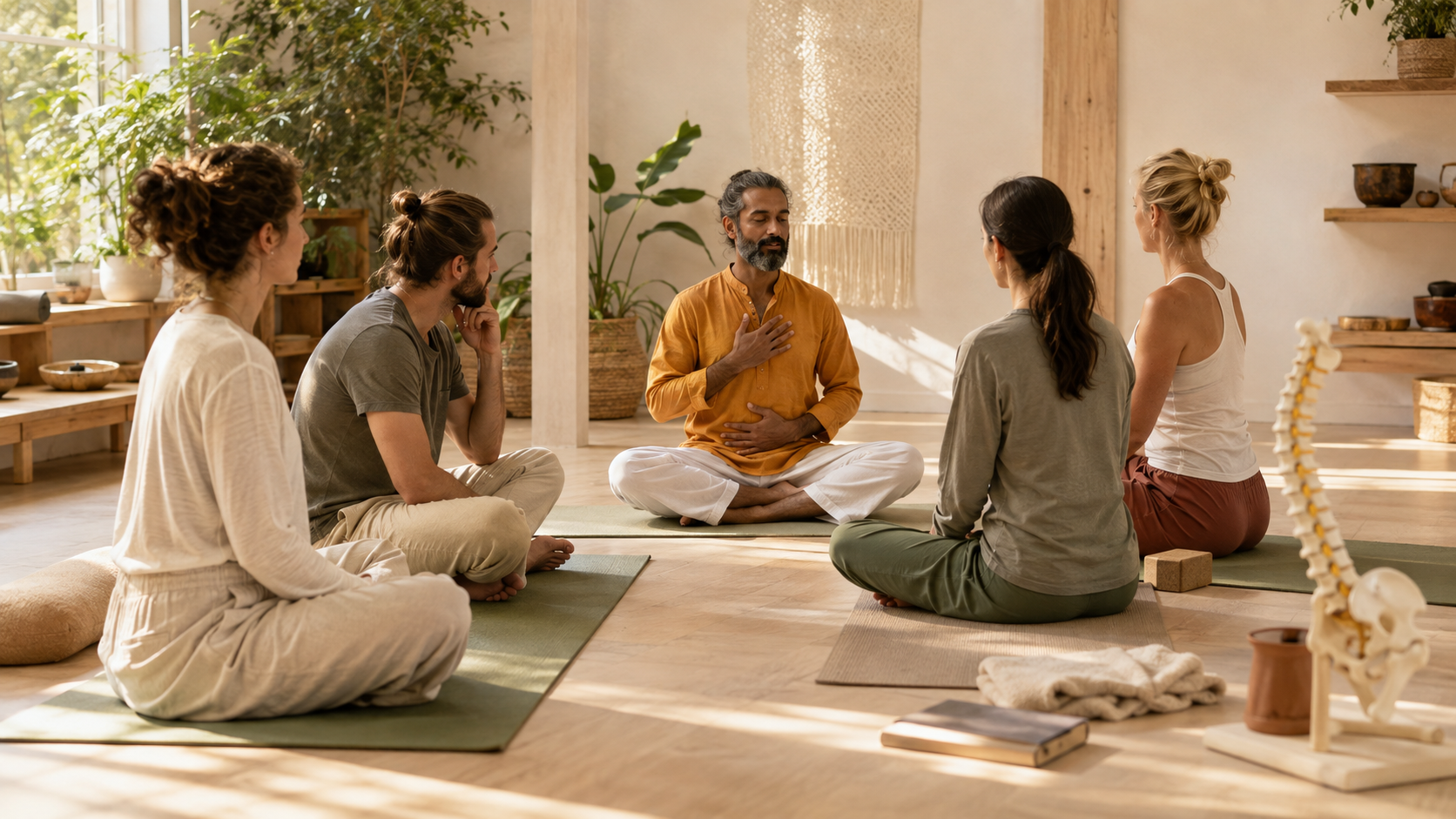
If you are considering becoming a yoga teacher, you may be wondering what actually happens during a 200-hour yoga teacher training course.
Will you spend hundreds of hours practising postures? Do you need to memorise the Sanskrit name of every asana? Will you be expected to teach a full class immediately?
The reality is much broader—and often more transformative—than people expect.
A good yoga teacher training programme is not simply an advanced exercise course. It introduces you to the physical, philosophical and practical foundations of yoga while helping you develop the confidence and communication skills needed to guide other people safely.
You do not have to arrive as an expert. Teacher training is where you begin learning how to move from being a yoga student to becoming a thoughtful, knowledgeable and responsible teacher.
What is a 200-hour yoga teacher training course?
A 200-hour yoga teacher training course is an established entry-level route for people who want to qualify as yoga teachers or deepen their understanding of yoga.
The training usually combines guided sessions, personal practice, theoretical study, observation and opportunities to practise teaching. Although the exact curriculum varies between schools, students will normally explore subjects such as yoga postures, breathing techniques, meditation, anatomy, philosophy and teaching methodology.
At Shiva Yoga in Liverpool, the teacher training programme includes more than 200 hours of learning delivered across 28 to 30 weeks. The weekly format gives students time to absorb the material, develop their practice and gradually build their teaching confidence.
But what will you actually learn?
1. How to practise and teach yoga postures
Asana—the physical practice of yoga—is an important part of teacher training, but the objective is not to perform the most impressive version of every pose.
You will learn to understand postures rather than simply copy them.
This includes exploring alignment, breathing, balance and the purpose of different movements. You will begin to notice how the same posture can feel very different from one person to another.
As a prospective teacher, you also need to learn how to explain a posture clearly. This means breaking movements into manageable steps, using accessible language and giving students enough time to respond.
You may explore variations that make a posture more appropriate for different abilities. This helps you create classes in which people feel supported rather than pressured to make their bodies look a particular way.
2. Anatomy and physiology
Understanding the body helps yoga teachers make more informed decisions about movement and sequencing.
During teacher training, you can expect to study relevant areas of anatomy and physiology, including the skeletal system, muscles, joints, breathing and how the body responds to movement.
You are not training to become a doctor or physiotherapist. However, you should develop enough understanding to recognise that bodies differ and that no posture will look identical for every student.
Anatomical knowledge can also help you avoid making unrealistic claims or encouraging students to force themselves into positions that are not appropriate for them.
It supports one of the most important responsibilities of a yoga teacher: creating a respectful environment in which students can listen to their own bodies.
3. Pranayama and the relationship between breath and practice
Breathing is central to yoga, yet many people first arrive at yoga classes without giving it much thought.
Pranayama refers to yogic breathing practices used to develop greater awareness and influence the quality of our physical and mental state.
Teacher training gives you time to explore different breathing techniques, understand how they are traditionally practised and learn how to introduce them to students.
You will also become more aware of the relationship between breath and movement. This can completely change how you experience familiar postures.
For a teacher, the challenge is not only knowing a breathing technique but also being able to explain it patiently, observe students and create a calm atmosphere in which they do not feel rushed.
4. Meditation and concentration
Meditation is another essential part of yoga that can sometimes receive less attention in modern, posture-focused classes.
During a comprehensive teacher training course, you will explore meditation as both a personal practice and something you may eventually guide for others.
This may involve learning how to sit comfortably, work with distractions, focus attention and observe thoughts without immediately reacting to them.
You may also practise guiding short meditations. This develops useful teaching skills such as pacing, vocal clarity and knowing when to allow silence.
You do not need to empty your mind or become perfectly calm before you can learn meditation. The purpose is to develop awareness through regular practice, not to achieve an artificial idea of perfection.
5. Yoga philosophy
Yoga is much more than a series of movements. Its traditions contain teachings about the mind, behaviour, self-awareness, relationships and how we approach everyday life.
Teacher training introduces students to key philosophical ideas and traditional texts. These teachings provide context for the physical practices and can encourage deeper reflection on why and how we practise yoga.
Studying philosophy does not mean that everyone must interpret yoga in exactly the same way. A good course creates space to ask questions and consider how traditional teachings can be understood responsibly in contemporary life.
For future teachers, this knowledge can bring greater substance to classes. It helps ensure that yoga is not reduced to stretching or physical performance.
6. Sanskrit and the language of yoga
Many familiar yoga terms come from Sanskrit, including asana, pranayama, dhyana and savasana.
Learning some Sanskrit can help you understand the roots of yoga and recognise commonly used names and concepts. You do not need to become fluent or feel embarrassed if pronunciation does not come naturally at first.
The objective is to build familiarity gradually and use terminology with care.
A teacher may choose to use both Sanskrit and English names during a class. What matters is communicating in a way that students can understand while respecting the traditions from which the practice developed.
7. How to plan and sequence a yoga class
Knowing individual postures is different from knowing how to organise them into a coherent class.
Teacher training helps you understand sequencing: how to move students from one part of a practice to another with purpose.
You may learn how to begin a session, prepare the body, develop a theme or focus, balance effort with rest and bring the practice to a suitable conclusion.
You will also need to think about who the class is for. A sequence for experienced practitioners may not be appropriate for complete beginners, older adults or people attending chair yoga.
Planning provides structure, but teaching also requires flexibility. You may arrive with a complete sequence and then realise that the people in front of you need something different. Training helps you develop the awareness to adapt.
8. How to communicate and hold space
One of the biggest changes during teacher training is learning to communicate while observing a room.
You need to give clear instructions, demonstrate when helpful, watch how students respond and create an atmosphere in which people feel welcome.
This takes practice.
Many trainees initially worry about forgetting what to say or losing their place in a sequence. Practising in a supportive environment allows you to make mistakes, receive feedback and gradually develop your own teaching voice.
A strong teacher does not need to sound like anyone else. Confidence comes from knowledge, preparation, experience and learning to communicate authentically.
9. Ayurveda, nutrition and the wider yogic tradition
Some teacher training programmes explore subjects that help students see yoga within a wider approach to living.
At Shiva Yoga, the curriculum includes Ayurveda, nutrition and the psychology of yoga alongside asana, meditation, pranayama and philosophy.
Ayurveda is a traditional Indian system concerned with balance, daily routines and the relationship between lifestyle and wellbeing. Studying its principles can provide useful historical and cultural context.
These subjects also encourage trainees to think beyond what happens during a one-hour class and consider how awareness, habits and personal practice influence everyday life.
10. What kind of teacher you want to become
Perhaps the most personal part of teacher training is discovering how you want to share yoga.
Some students want to teach full-time. Others hope to run a weekly class alongside their existing career. You might want to support a particular community, work with beginners or simply deepen your knowledge before deciding whether teaching is right for you.
You do not need to have your entire career planned before enrolling.
Through practice, study and conversations with your fellow trainees, you may begin to understand which parts of yoga feel most meaningful to you and how you would like to communicate them.
Teacher training is also personal training
Even when your goal is to teach other people, much of the learning begins with your own practice.
You may become more aware of your habits, expectations and insecurities. You might discover that postures you once avoided become valuable teachers, or that breathing and meditation begin to matter as much as physical movement.
This personal development is not separate from learning to teach. It is part of the process.
Experiencing uncertainty, progress and change can help you relate more compassionately to future students who are beginning their own journeys.
Do you need to know everything before you start?
No. You are joining a training course because you want to learn.
You do not need exceptional flexibility, advanced postures or detailed knowledge of yoga philosophy. Curiosity, commitment and a willingness to practise consistently are far more useful.
If you are thinking about enrolling, the next step is to consider how you can prepare physically, practically and mentally. Read our guide on how to prepare for yoga teacher training for a realistic checklist you can follow before the course begins.
Explore yoga teacher training in Liverpool
Shiva Yoga’s 200+ hour teacher training programme is led by Mohan, who began his yoga journey in India in 1981 and has been teaching since 1987.
The course brings together traditional knowledge and practical teaching preparation. Subjects include asana, pranayama, meditation, anatomy and physiology, yoga philosophy, Ayurveda, Sanskrit, nutrition, chair yoga and the psychology of yoga.
Training takes place weekly in Speke, Liverpool, allowing students to develop their knowledge and confidence over time.
If you are interested in becoming a yoga teacher—or simply want to explore yoga more deeply—you can contact Shiva Yoga to ask questions and find out whether the course is right for you.